Commercial Roofing Materials Compared: TPO, EPDM, Metal & Modified Bitumen
What is the best commercial roofing material? There is no single system that is right for every building.
A warehouse with a large low-slope roof may need a different material than a retail building with a visible pitched roof. An owner planning to keep a property for 30 years may also choose differently than someone preparing to sell in five. Budget, drainage, rooftop equipment, foot traffic, insulation, energy use, and Utah’s weather all affect the decision.
The most common types of commercial roofing include TPO, EPDM, metal, modified bitumen, and built-up roofing. Each can perform well when the complete roof assembly is designed correctly and installed by an experienced commercial roofer. Material matters, but so do membrane thickness, insulation, flashing, drainage, fastening, workmanship, and maintenance.
This guide compares the leading options so you can understand their strengths, limitations, expected service life, and best uses.
How to Choose a Commercial Roofing Material
Before comparing products, start with the building itself. The right roof is the one that fits the structure, daily use, ownership plan, and budget.
Roof Slope and Drainage
TPO, EPDM, modified bitumen, and BUR are commonly used on flat and low-slope commercial roofs. Metal is often used on sloped buildings, and certain standing-seam systems can work on low-slope applications when designed for that use.
No material can make up for poor drainage. Ponding water stresses seams, flashing, insulation, and the roof deck. Before replacement, the contractor should inspect drains, scuppers, gutters, slope, and low areas.
For a closer look at membrane roofs, read our guide to flat roofing systems.
Upfront Cost Versus Life-Cycle Cost
The lowest bid is not always the least expensive roof. A system that costs more initially may last longer, need fewer repairs, reduce cooling demand, or better support future solar panels.
Consider how long you expect to own the building. Long-term owners may benefit from a thicker membrane, durable cover board, upgraded insulation, or metal system. A dependable mid-range system may make more sense for a shorter ownership plan.
Energy Goals
White TPO and other reflective surfaces can reduce the solar heat absorbed by a roof. The U.S. Department of Energy identifies TPO and PVC as commonly white, reflective single-ply membranes and notes that reflective options are also available for metal and other roof types.
Reflectivity is only one part of roof performance. Insulation, air leakage, rooftop equipment, building use, and local utility rates also influence energy costs.
Rooftop Traffic and Equipment
Commercial roofs often hold HVAC units, vents, pipes, solar equipment, and communications systems. If technicians regularly cross the roof, puncture and impact resistance become more important.
Modified bitumen and multi-ply systems are often selected for regular service traffic. TPO and EPDM can also work well, but walk pads, cover boards, designated routes, and careful flashing may be needed.
Installation Quality and Warranty
A strong material can fail early when seams, edges, drains, or penetrations are installed incorrectly. Manufacturer-approved details, trained crews, proper weather conditions, and final inspections matter as much as the product name.
Warranty length also does not automatically equal expected roof life. Review what the warranty covers, required maintenance, exclusions, and whether the system must be installed by a certified contractor. Commercial manufacturer guarantees may range from around 10 to 35 years depending on the system, contractor qualifications, and coverage selected.
TPO Roofing
Thermoplastic polyolefin, usually called TPO, is a common single-ply membrane for commercial flat and low-slope roofs. It is typically installed in large white sheets with heat-welded seams.
TPO is popular because it balances cost, energy performance, and installation speed. A white membrane reflects more sunlight than a dark roof surface, which can help reduce rooftop heat gain during Utah summers.
Advantages of TPO Roofing

TPO is often a strong fit for offices, retail buildings, warehouses, multifamily properties, and other facilities with broad low-slope areas. Its main advantages include a reflective surface, welded seams, competitive cost, multiple thickness options, and compatibility with many insulation and cover-board systems.
A properly formulated and maintained TPO membrane may provide an estimated 25 to 30 years of service. Actual performance depends on thickness, attachment method, climate, drainage, and workmanship. Some thicker and upgraded TPO systems may qualify for longer manufacturer guarantees.
Limitations of TPO Roofing
TPO is a single-ply system, so sharp tools, dropped equipment, loose fasteners, and repeated foot traffic can puncture it. A harder cover board beneath the membrane and designated walk pads can improve protection.
Products also vary by manufacturer and specification. A thin, low-cost membrane should not be compared directly with a thicker reinforced system designed for a longer warranty.
When TPO May Be the Best Choice
TPO is often the best all-around option for a Utah commercial building when the owner wants a reflective low-slope roof, moderate upfront cost, and a widely available system.
It is especially practical for large commercial roof areas where an architectural standing-seam metal roof would be significantly more expensive.
EPDM Roofing

EPDM is a synthetic rubber membrane that has been used on commercial buildings for decades. It is most commonly black, although white EPDM products are available.
Unlike TPO, EPDM seams are joined with tapes, adhesives, primers, and manufacturer-specific accessories rather than hot-air welding. The flexible membrane can accommodate temperature changes and seasonal movement.
Advantages of EPDM Roofing
EPDM has a long track record and is valued for flexibility, weather resistance, and repairability. Large sheets can reduce the number of field seams, especially on open roofs with few penetrations.
The EPDM Roofing Association reports an expected service life of about 38 years for properly designed, installed, and maintained membranes. Roofing professionals surveyed by the association placed many EPDM systems within a 25- to 40-plus-year service-life range, depending on membrane thickness and attachment method.
Limitations of EPDM Roofing
Standard EPDM is dark, so it can become hotter in direct summer sun than a white reflective membrane. White EPDM or another reflective system may be preferable for buildings with high cooling demand.
Seams, flashing, penetrations, and previous repairs still need careful inspection. The membrane may remain serviceable while poorly installed or aging details become leak points.
When EPDM May Be the Best Choice
EPDM is a strong option for owners who value proven performance, flexibility, and repairability. It can be especially attractive on large, uncomplicated roofs where a dark membrane does not create a major cooling concern.
It may also be worth considering when the existing roof design already uses EPDM and the insulation, drainage, and roof deck remain in good condition.
Commercial Metal Roofing
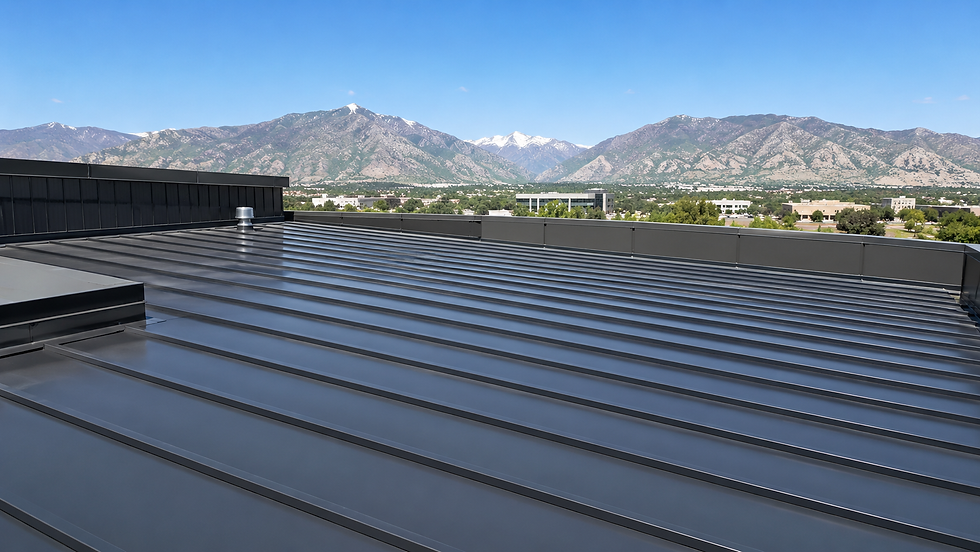
Commercial metal roofing includes standing-seam panels, exposed-fastener panels, structural systems, and retrofit assemblies. Standing-seam systems hide the fasteners beneath raised seams and allow panels to move as temperatures change.
Metal usually has the highest initial cost in this comparison, but it may also provide the longest service life. Research published by the Metal Construction Association found that properly designed coated steel standing-seam roofs can exceed 60 years in suitable environments.
Advantages of Commercial Metal Roofing
Metal offers a long service life, strong weather resistance, low routine maintenance, a clean architectural appearance, and compatibility with many solar mounting systems. Retrofit options may also reduce the need for a complete tear-off.
It is commonly used on warehouses, manufacturing facilities, retail buildings, agricultural structures, offices, and properties where the roof is visible from the ground.
Commercial metal roofing can be a particularly strong investment for an owner who expects to keep the building for several decades. Although the installation may cost more initially, the longer service life can reduce the number of full replacements needed over the life of the property.
Limitations of Commercial Metal Roofing
Performance depends heavily on panel design, slope, fastening, seams, coatings, transitions, and flashing. A basic exposed-fastener roof is not the same as an engineered standing-seam system.
Thermal movement must be accounted for. Panels expand and contract as temperatures change, so clips, seams, penetrations, and perimeter details must allow controlled movement.
Snow retention may also be needed above entrances, sidewalks, loading areas, and equipment. Dents, coating damage, corrosion risk, and noise should be considered based on the metal type and building use.
When Metal May Be the Best Choice
Metal may be the best commercial roofing material for a sloped building, a long-term ownership plan, or a project where durability and appearance justify the higher initial investment.
It can also work for certain low-slope buildings and roof-over retrofit projects, but the assembly must be designed for the building’s slope, structure, drainage, and expected snow load.
Modified Bitumen and Built-Up Roofing
Modified bitumen roofing is an asphalt-based membrane reinforced with polymers and internal reinforcement. It is usually installed in multiple layers or as part of a hybrid system. Common types include SBS and APP.
SBS-modified bitumen is known for flexibility and impact resistance. APP-modified bitumen is formulated for heat resistance and is often torch-applied, although self-adhered and cold-applied systems are also available.
Built-up roofing, or BUR, is the traditional tar-and-gravel style of commercial roof. It uses multiple layers of asphalt and reinforcing felt, usually finished with gravel, a mineral cap sheet, or a coating.
Advantages of Modified Bitumen Roofing
Modified bitumen provides more than one layer of protection and can handle regular rooftop activity better than many basic single-ply assemblies. It is often a good fit for smaller roofs, roofs with many penetrations, and facilities where crews frequently service rooftop equipment.
It also offers strong puncture resistance, multiple installation methods, granulated cap-sheet options, and familiar repair methods.
Premium SBS systems can qualify for warranties of 20 to 30 years, while certain APP torch-applied systems are often designed around 15- to 20-year warranty periods.
BUR provides redundant waterproofing because it contains several layers. Gravel-surfaced systems can resist impact, traffic, and UV exposure.
Limitations of Modified Bitumen and BUR
These systems are heavier and more labor-intensive than many single-ply roofs. Some installation methods involve hot asphalt, open flame, fumes, or longer schedules. Building access, fire safety, occupied operations, and structural loading should be reviewed first.
BUR leaks can also be harder to trace because moisture may travel between layers before appearing inside the building.
When Modified Bitumen or BUR May Be the Best Choice
Modified bitumen is often a good choice for smaller roofs, high-traffic areas, complex layouts, and properties where puncture resistance is a priority.
BUR may make sense when replacing or restoring a similar existing assembly or when the owner wants the added protection of a traditional multi-ply system.
Commercial Roofing Cost and Lifespan Comparison
This is a planning comparison, not a quote. Roof size, tear-off, insulation, deck repairs, drainage work, access, material thickness, warranty, and labor costs can change the final price.
Roofing material | Relative installed cost | Typical lifespan | Best suited for | Main tradeoff |
TPO | Moderate | 20 to 30 years | Large flat and low-slope roofs | Single-ply membrane can be punctured |
EPDM | Low to moderate | 25 to 40+ years | Large, uncomplicated roofs | Black membrane absorbs more heat |
Standing-seam metal | High | 40 to 60+ years | Sloped roofs and long-term ownership | Higher upfront cost |
Modified bitumen | Moderate to high | 15 to 30 years | High-traffic and detailed roofs | More labor and installation complexity |
Built-up roofing | Moderate to high | 15 to 25 years | Multi-ply protection and existing BUR buildings | Heavy and potentially disruptive |
These lifespan ranges are general planning estimates. Manufacturers and roofing associations report that TPO can provide roughly 20 to 30 years, upgraded EPDM may provide 25 to 40 years or longer, metal can reach 40 to 60-plus years, and modified bitumen or BUR commonly falls between approximately 15 and 30 years.
Do not choose from lifespan alone. A long-life material installed over wet insulation or a damaged deck will not provide reliable performance. The contractor should evaluate the full assembly and explain which upgrades affect the price.
What Is the Best Commercial Roofing Material for Utah’s Climate?
For many Utah flat and low-slope buildings, TPO is the most practical all-around choice. It offers a reflective surface, moderate cost, and broad availability for offices, retail properties, warehouses, and similar facilities.
That does not make TPO the automatic winner.
EPDM may be better when flexibility, repairability, and long-term membrane performance are the top priorities. Metal may provide the best long-term value for sloped buildings or owners keeping a property for several decades. Modified bitumen may be better for roofs with heavy service traffic, many penetrations, or higher puncture risk.
Utah roofs may face intense summer sun, cold winters, snow, wind, and large temperature changes. National Weather Service climate information for Salt Lake City documents significant seasonal temperature changes and an average annual snowfall historically measured at more than 60 inches at the airport. Drainage, structural loading, flashing, and snow management should therefore be treated as important parts of the roof design.
The best Utah commercial roofing system should account for roof slope, drainage, snow and ice, summer heat, wind exposure, rooftop traffic, insulation, ownership period, and maintenance budget.
In many cases, the best answer is not simply “TPO” or “metal.” It may be a thicker TPO membrane over high-density cover board, a 90-mil EPDM system with upgraded flashing, or a standing-seam metal retrofit with new insulation.
Diamond Ridge Contractors inspects the existing membrane, roof deck, insulation, penetrations, drainage, perimeter metal, and signs of trapped moisture before recommending repair or replacement. Our commercial roofing services include inspection, repair, replacement, insurance support, and maintenance for Utah businesses and property owners.
Get a Commercial Roof Assessment
The best commercial roofing material is the one that protects your building, supports your budget, and matches how you plan to use the property.
Diamond Ridge Contractors can compare repair, restoration, recover, and replacement options for your roof. We will explain the materials, system details, expected service life, warranty choices, schedule, and potential disruptions before work begins.
Contact Diamond Ridge Contractors to schedule a commercial roof assessment and get a clear recommendation for your Utah property.


Comments