Flat Roofing for Commercial Buildings: Types, Pros & Cons, and Costs
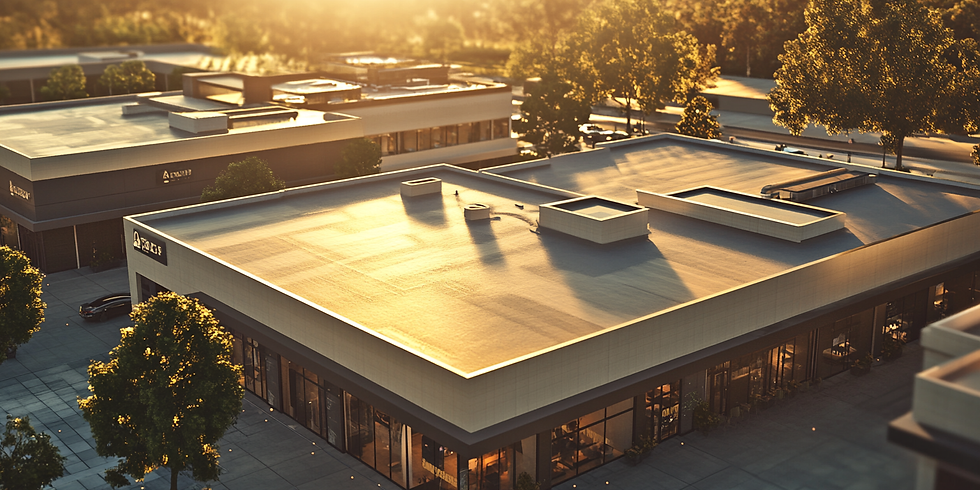
If you own or manage a commercial building, odds are good you are standing on top of a flat roof right now. Almost every warehouse, retail center, office park, and restaurant in Utah is built with one. And most owners do not think about that roof at all until it starts leaking over the sales floor.
This guide is written for that building. We are talking commercial flat roofing here, not the small flat section over somebody's garage. The systems, the costs, and the decisions are different when you are covering 5,000 or 50,000 square feet.
Here is the short version. Commercial flat roofing runs roughly $4 to $10 per square foot installed in 2026, and the four systems you will actually be choosing between are TPO, EPDM, modified bitumen, and built-up roofing. Which one is right depends on your building, your climate, and how long you plan to own the place. Let's break it down.
What Is a Flat Roof (and Why Commercial Buildings Use Them)
A flat roof is not actually flat. Every good one is built with a slight slope, usually a quarter inch of pitch per foot, so water drains instead of pooling. Calling it "low-slope" is more accurate, but nobody says that, so flat roof it is.
Commercial buildings lean on flat roofing for reasons that come down to money and function:
It is cheaper to cover big footprints. Pitched roofs get expensive fast over large spans. A flat roof covers a warehouse or a big-box store for a fraction of the cost per square foot.
It creates usable space. Your HVAC units, exhaust fans, condensers, and increasingly your solar arrays all live up there. A flat roof gives you a platform for the mechanical equipment a commercial building needs.
It is easier and safer to maintain. Techs can walk a flat roof to service units, clear drains, and inspect seams without rappelling off a steep pitch. That matters when you are maintaining a building for 20 years.
That is why flat roofing is inherently a commercial product. It solves commercial problems.
Flat Roofing Systems: TPO, EPDM, Modified Bitumen, and BUR
There is no single best flat roof. There is a best flat roof for your building. Here are the four systems worth knowing.

TPO (Thermoplastic Polyolefin)
TPO is the modern default, and it is not close. It makes up more than half of new commercial flat roof installs in the country. It is a single-ply white membrane with heat-welded seams, which means fewer weak points where leaks start. The white surface reflects sunlight, so it keeps cooling costs down, and it qualifies as an ENERGY STAR cool roof. For most Utah commercial buildings, TPO is the first system we would put on the table.
EPDM (Rubber)
EPDM is a black rubber membrane that has been around for decades, and some installs from the 1970s are still holding. It is tough, it handles freeze-thaw cycles well, and it is one of the easiest membranes to repair when something does go wrong. The tradeoff is that black rubber absorbs heat instead of reflecting it, so it is less energy efficient than TPO unless you go with a coated version. It is a strong long-haul choice, especially for owners planning to hold a building for 30 years or more.
Modified Bitumen
Modified bitumen is the modern evolution of old-school asphalt roofing. It uses asphalt reinforced with polymers, either rubber-based (SBS) or plastic-based (APP), applied in multiple plies. That layering gives it real puncture resistance, which is handy on roofs that see a lot of foot traffic. It is proven and reliable. The catch is a shorter lifespan than the single-ply options, so it can look cheap up front and cost more over the life of the building.
BUR (Built-Up Roofing)
BUR is the classic tar-and-gravel roof, built from alternating layers of asphalt and reinforcing fabric. It is genuinely durable and those extra layers seal small punctures before they become leaks. But it is heavy, at four to five pounds per square foot, and slow to install, which is why it is rarely specified on new construction anymore. You will mostly see it on older buildings that already have it.
Flat Roofing Pros and Cons
Flat roofing is the right call for commercial buildings, but it is not magic. Know the tradeoffs going in.
The pros:
Lower cost per square foot than pitched roofing over large areas
Usable rooftop real estate for HVAC, solar, and equipment
Easier, safer access for inspections and maintenance
Reflective options like white TPO cut cooling costs in Utah summers
Faster installation on most single-ply systems
The cons:
Drainage takes design and upkeep, and standing water is the number one enemy
Generally shorter lifespan than a quality pitched roof
Seams and flashing are common failure points if installed poorly
Snow and debris load has to be planned for, which matters along the Wasatch Front
None of these are dealbreakers. They are just reasons that installation quality and ongoing maintenance matter more on a flat roof than almost anywhere else on your building.
Cost and Lifespan
This is the part most owners skip to, so here it is straight. These are 2026 installed ranges for commercial work, before tear-off of your old roof, which typically adds another $1 to $3 per square foot.
TPO: about $5 to $9 per square foot, lasting 20 to 30 years
EPDM: about $4 to $9 per square foot, lasting 25 to 30 years, longer on thicker fully-adhered systems
Modified bitumen: about $4 to $10 per square foot, lasting 15 to 25 years
BUR: about $4 to $10 per square foot, lasting 20 to 30 years
To put that in building terms, a 5,000 square foot commercial roof commonly runs $20,000 to $75,000 installed, and a 50,000 square foot big-box roof can land anywhere from $200,000 to $700,000 depending on the system and the tear-off. Smaller roofs under 1,000 square feet pay a premium per foot because crew mobilization and material minimums do not scale down.
One thing worth saying plainly: the cheapest membrane is rarely the cheapest roof. A system that lasts 15 years instead of 30 costs you a second full replacement inside the same window. Look at cost per year of service life, not just the number on the bid. If you want a deeper side-by-side, our guide to commercial roofing materials walks through the full comparison.
Flat Roof Maintenance Basics
A flat roof is not a set-it-and-forget-it purchase. The good news is that a little attention doubles the life you get out of it. The National Roofing Contractors Association recommends inspecting commercial roofs at least twice a year, and that is solid advice.
Keep it simple and stay ahead of these:
Clear the drains. Clogged drains and scuppers cause ponding water, and ponding water is what kills flat roofs. Leaves, debris, and gravel need to come off.
Inspect after storms. Wind, hail, and heavy snow all stress a membrane. A quick look after a rough Utah winter catches damage before spring runoff finds it.
Watch the seams and flashing. Most leaks start where the membrane meets something else: a wall, a drain, a rooftop unit. These are the spots to check.
Handle rooftop traffic carefully. Every HVAC tech and satellite installer who walks your roof is a potential puncture. Walk pads and clear access paths protect the membrane.
Twice-a-year inspections and prompt small repairs are the cheapest money you will ever spend on a building.
When to Repair vs Replace
Not every leak means a new roof. Here is the rough logic we use.
Repair makes sense when the roof is still within its expected lifespan, the damage is localized, and the membrane overall is in good shape. A punctured seam or a failed flashing detail on a ten-year-old TPO roof is a repair, full stop.
Replacement makes sense when the roof is near or past its service life, when leaks are showing up in multiple spots, when the insulation underneath is wet, or when you are patching the same roof year after year. Chasing leaks across an old, saturated roof is throwing good money after bad. At that point a full replacement is cheaper over five years than the repair treadmill.
When it is genuinely borderline, get a professional inspection before you decide. A good roofer will tell you honestly whether you are buying a few more good years or just delaying the inevitable.
Get the Right Flat Roof for Your Building
Flat roofing is one of those decisions that quietly determines your maintenance costs, your energy bills, and your headaches for the next 20 to 30 years. Getting the system, the installation, and the maintenance plan right up front is worth far more than saving a dollar a square foot on the bid.
That is where we come in. Diamond Ridge Contractors provides commercial roofing services across Utah, from new installs and full replacements to repairs and maintenance programs that keep your roof out of trouble. Whether you are weighing TPO against EPDM or trying to decide if that aging roof has another season in it, we will give you a straight answer.
Talk to our team about your commercial roofing project and get a real assessment of your building.


Comments